It seemed to be a bottomless pit. There was a void in this area of my life and I am sure now that this was simply an undefined area. Apparently invisible, but a real place nonetheless. The word that I uttered in that moment is the word, and upon this discovery, something very precise occurred within myself. There was a definite clean shift. A final keystone locked into place, almost as if a vertebrae in my spine had been missing and was suddenly placed back in, from where it had been missing. This is simply a phenomenon from filling this empty void with the missing definition of my journey.
"You are such a dreamer Mike! When will you come back to reality"
Well! This type of comment no longer has the possibility of affecting me ever again. The dreams now have the conduit to bring them into my world. Dreamers are creators and creators are the ones that build this world. They have the power to push through all the barriers in their way, no matter what, all the while fuelled by the power of their dreams.
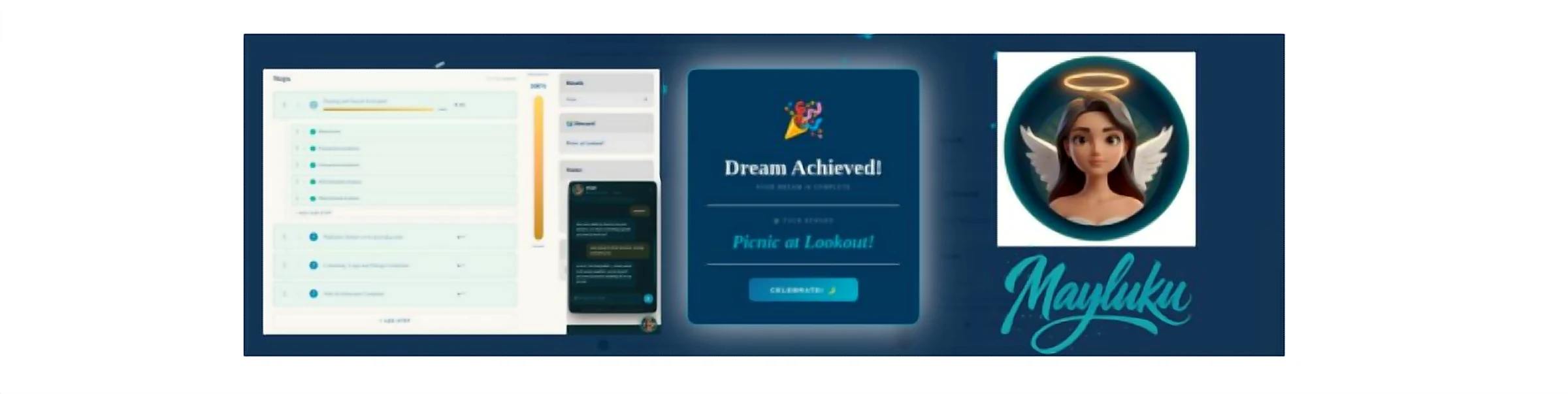
Without any further adieu, I bring you the missing definition. Not just a definition, but a platform in which your greatest dreams can manifest and become a meaningful and deserved part of your life.
Mayluku
ˈmeɪ…luːkuː · may-LOO-koo
· noun, verb
Definitions
- n. The act of speaking a thing into existence; the space between wishing and building. "What started as a Mayluku is now the whole design."
- v. (mayluku'd, mayluku'ing) To bring an idea into form by naming and shaping it, without waiting for permission. "She mayluku'd the treehouse before anyone told her she could."
- n. (proper) A platform for building worlds, dreams, and designs by declaring them into structure. "Sketch it, name it, mayluku it — that's the whole method."
- informal. Making things happen. "Enough talking about it — let's mayluku this."
- n. The right to create. "To build the garden of my dreams. This is my mayluku."
Derivation
From English may, from Old English mæg ("am able"), from Proto-Germanic *magan, from the Proto-Indo-European root *magh- ("to be able, to have power") — the same root that produced might (strength, force) and, more distantly, magic (Greek mágos). English later softened the word into a verb of blessing and permission ("may you...").
Fused with luku, from Finnic luku ("reading; incantation; spell"), ultimately from a root meaning "to read, to count" — the act of reading a thing into being.
Synonym Study
Mayluku, envision, manifest, and conjure all describe bringing something into form through will or imagination, but they differ in force and posture.
Envision: emphasizes internal picturing — the idea stays a mental image, private and unformed.
Manifest: implies a claim on future outcome, often through belief or intention alone; the method between wish
and result is left unstated.
Conjure: carries a theatrical, sudden quality — something appears as if from nothing, with an implication of trickery or performance.
Mayluku differs from all three: it names both the power to act (the may root) and the method of shaping (the luku root, "to read/spell") in a single word. Where envision stays private, manifest stays vague, and conjure stays performative, mayluku denotes a deliberate, structured act — the idea is not just imagined or wished for, but read into a real, buildable shape.
See also: might · magic · incantation · canon
The bridge is now in place and from here, you can truly understand your dreams and bring them to life.
Dreams
driːmz · dreemz · noun, verb
Definitions
- n. A personal creation, experience, or state of being one wishes to bring into their world; the imagined form before it is built.
- n. The raw material of a Mayluku — what is felt or wished for, before it is read into structure.
- v. informal. To hold something as possible, without yet building it. "I used to just dream about it. Now I mayluku it."
Derivation
From Old English drēam ("joy, mirth, music, noisy merriment"). The sense shifted toward "a sequence of images and sensations occurring in sleep" in early Middle English, likely under the influence of Old Norse draumr, Old Saxon drōm, and Old High German troum — all from a Proto-Germanic root, *draugmaz, of uncertain deeper origin. The word has carried both meanings — joy, and vision — for most of its life; only later did "dream" narrow toward the imagined and unbuilt.
Synonym Study
Dream, vision, aspiration, and fantasy all name something wanted that does not yet exist, but they differ in how real the wanting is meant to become.
Vision: implies clarity and specificity — often strategic, often shared or institutional, already halfway to a plan.
Aspiration: emphasizes the reaching more than the destination — tied to identity and status, a direction rather than a shape.
Fantasy: carries a built-in acknowledgment of unreality — imaginative, often not meant for the world at all.
Dream differs from all three: it is personal and unshaped, closer to feeling than to plan — the rawest material, before form. Where vision is already structured and fantasy expects no structure, a dream is simply waiting for one. That's what a mayluku is for.
See also: mayluku · canon · possibility
This platform is here for you now: Mayluku
Angel is waiting and read to help: 
Mike King